Climate Registered™ Accelerator Spotlight:
AC Transit
By: Anna Benjamin
 AC Transit
 AC Transit
Recognition Tier: Champion
Based in Oakland, California, Alameda-Contra Costa Transit District (AC Transit) operates the largest bus-only public transit system in the state and the third-largest in the nation. To earn Climate Registered™ Champion status, AC Transit met rigorous criteria, such as:
- Publishing a verified base year,
- Completing at least three third-party verified emissions inventories within the past five years, and
- Setting a public emissions reduction target to reduce emissions by 50% by 2030 and 97% by 2040.
AC Transit has developed a comprehensive Climate Action and Sustainability Plan outlining its key goals, targets and actions. AC Transit has already made substantial progress, achieving a 31% reduction in emissions in 2022 compared to its 2006 baseline year. AC Transit’s decarbonization strategies include:
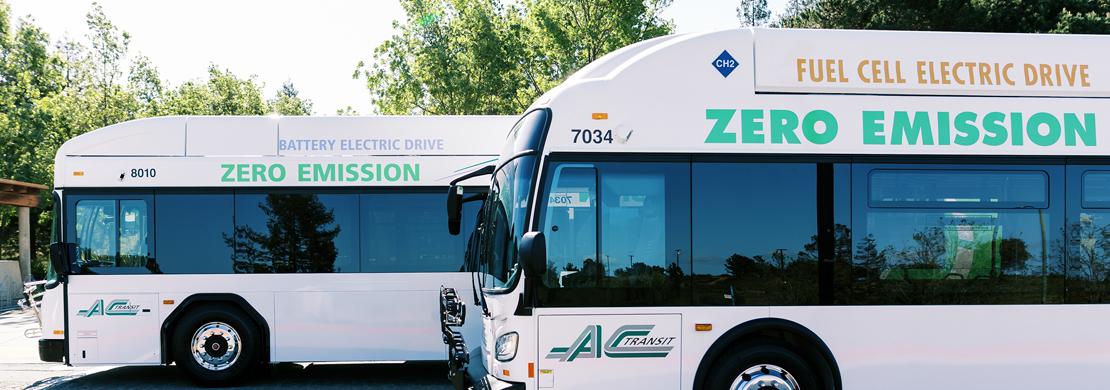
- Converting to a 100% zero-emissions bus fleet: A cornerstone of AC Transit’s greenhouse gas (GHG) reduction strategy is the full transition to a 100% zero-emissions bus fleet. With approximately 630 buses in operation—historically accounting for nearly 90% of the agency’s total GHG emissions—decarbonizing the fleet represents the biggest opportunity to reduce GHG emissions. To date, 9% of the fleet has been converted to zero-emission vehicles, including both hydrogen and battery electric buses. AC Transit is aiming to achieve full fleet conversion by 2040.
- Reducing facility energy use: The agency has set clear targets for lowering energy consumption: complete energy audits for 100% of its facilities by 2025, reduce facility energy use by 25% by 2030 as compared to 2019 levels, and achieve a 50% reduction in facility energy use by 2040. To meet these goals, AC Transit is focused on expanding its use of renewable energy, improving building energy efficiency, and enhancing energy resilience.
- Reducing facility waste and water usage: To reduce waste, AC Transit is improving operational practices such as minimizing plastic use and increasing composting, recycling and reuse efforts. The agency aims to reduce municipal solid waste by 25% by 2034, compared to 2019 levels. In terms of water conservation, AC Transit plans to enhance monitoring and efficiency through strategies like consumption tracking, water-use audits, and installing motion-sensor fixtures. The goal is to reduce water use by 40% by 2034 relative to 2019.
- Building awareness: AC Transit wants to help its riders understand the positive impact they are having by taking public transit and reducing their carbon footprint. In celebration of Earth Day 2022, AC Transit added an environmental savings calculator to its Trip Planner. Under “Trip Details,” riders can see how many pounds of carbon dioxide (CO2) were saved by taking the bus instead of driving.
Stay up to date on AC Transit’s progress toward its sustainability goals by exploring its Climate Action and Sustainability Plan and annual Sustainability Update Reports, which provide transparent insights into both the highlights and challenges AC Transit encounters on its path to reducing GHG emissions.
“AC Transit appreciates that The Climate Registry provides a public and transparent platform to document and share our greenhouse gas emission inventories year after year. We continue to take meaningful, outcome-based actions, both short and long-term, to protect and sustain our natural environment and reach our goals of a zero-emission bus fleet and low-emission facility operations.” -David Wilkins, Director of Bus Rapid Transit
Members can submit an application today to be recognized as a Climate Registered™ Accelerator! Applications for the Climate Registered Accelerator are accepted year-round. If you missed our webinar detailing the criteria for the new program and how to apply, the recording and slide deck are available.