Climate Registered™ Accelerator Spotlight:
The Johns Hopkins University
Prepared by Elsie Andreyev for The Climate Registry; revised by Johns Hopkins University.
“After meeting its goal to reduce greenhouse gas emissions 51% by 2025 three years early, JHU set out to establish a new target for achieving net zero emissions. Making sure that emissions data was accurate, consistent, and in alignment with global standards was a significant priority. This is why JHU joined The Climate Registry—to become part of a network of industries working together around climate action and data integrity and to leverage TCR’s expertise and guidance on complex accounting standards.”
– Agathe Pierot, Sustainability Manager, Climate Action, Johns Hopkins University Office of Climate & Sustainability
The Johns Hopkins University (JHU)
Recognition Tier: Champion
TCR Member since 2021

Based in Baltimore, Maryland, Johns Hopkins University (JHU) is making strides in its efforts to achieve net-zero Scope 1 and Scope 2 emissions by 2040, as set forth in the university’s comprehensive Climate Action and Sustainability Plan. JHU met its initial goal of reducing greenhouse gas (GHG) emissions 51% by 2025, compared to a 2008 baseline, three years ahead of schedule; and the university is continuing to work towards a goal to reduce Scope 1 emissions 20% by 2030. JHU’s new climate goals were set after a comprehensive study of university-wide decarbonization scenarios, and an accelerated target of 2040 was determined to ensure the institution serves as a leader in decarbonization within higher education.
To earn Climate Registered™ Champion status, JHU met rigorous criteria, such as:
- Publishing a verified base year,
- Completing at least three third-party verified emissions inventories within the past five years, and
- Setting a public emissions reduction target.
Renewable Energy & Solar Infrastructure
Strategic power‑purchase agreements supply clean electricity for campus operations, and JHU is also working to expand carbon-free generation across its campuses. In 2024, 77% of JHU’s purchased electricity was from renewable and carbon-free sources, and JHU has committed to reaching 100% by 2030.
- In 2019, JHU signed a 15-year agreement with Constellation to purchase 250,000 MWh of clean energy annually, marking the largest such deal in Maryland, and for any individual U.S. university nationally at the time. Combined with energy efficiency measures, the agreement allowed JHU to cut its GHG emissions in half three years ahead of schedule.
- The agreement with Constellation includes energy from the Skipjack Solar Center, a new solar facility built in Virginia as a result of JHU’s financial contract, with over 500,000 panels producing more than 350,000 MWh per year, of which JHU is the largest off-taker. The solar contract helped reduce the university’s GHG emissions by almost 80,000 metric tons of CO2 in 2024 – the equivalent of removing more than 18,000 cars from the road for a year.
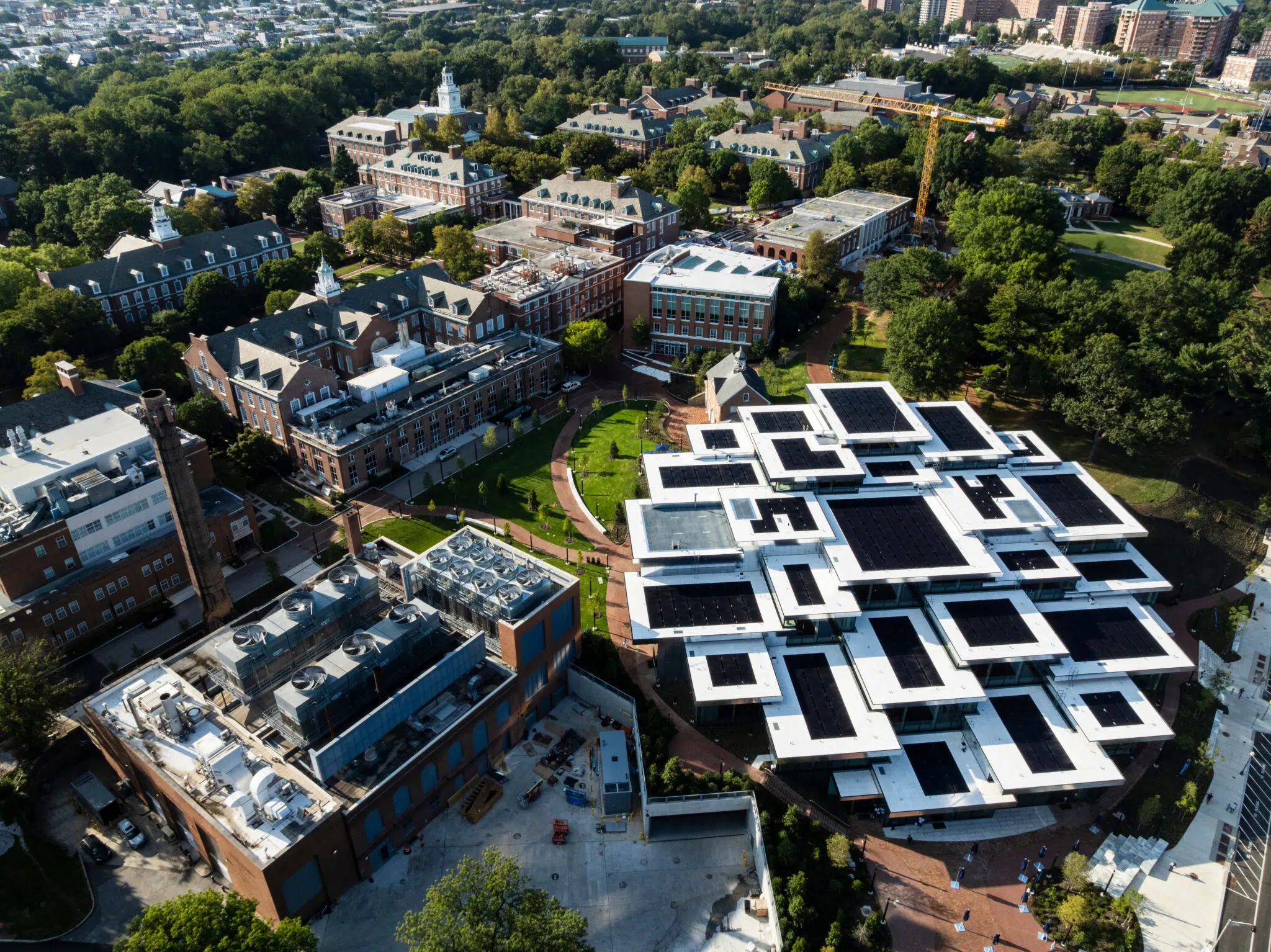
- With solar arrays on seven buildings, Johns Hopkins has some of Baltimore’s largest rooftop solar systems. The newly-constructed Bloomberg Student Center features 29 roofs with over 1000 photovoltaic panels producing up to 40% of the building’s annual electricity consumption.
Planning for Net-Zero New Buildings
Reducing emissions from building operations is central to JHU’s plans for achieving net-zero emissions. Approximately 97% of the university’s GHG emissions are associated with energy used for heating, cooling, ventilation, and research activities in building across a multitude of campuses. In addition to reducing emissions from existing facilities – new construction, major renovation, and modification projects present a unique opportunity to integrate high-performance, healthy, and energy-efficient building design strategies, avoiding costly and disruptive retrofits in the future.
JHU’s new High Performance and Healthy Building (HPHB) Requirements, adopted in 2024 and implemented on a number of projects, codify those strategies. In addition to focusing on low-carbon new construction, JHU’s building requirements contribute to prioritizing large-scale renovations and retrofits of existing facilities, as well as decarbonizing district energy systems and electrifying standalone building systems.
Specific HPHB Requirements include:
- All standalone new construction and major renovations are to be all-electric – including space heating, domestic hot water, and commercial kitchens – while all new construction and major renovations connected to a central plant will build in the capacity to accept low-temperature hot water in place of steam.
- All projects involving modifications to or replacements of fossil-fuel burning equipment will transition equipment to all-electric.
- In addition, the HPHB Requirements set ambitious standards for energy efficiency, mandatory embodied carbon benchmarking, and establish a minimum LEED Gold certification requirement for new construction and major renovations.
Energy Conservation and Efficiency
Because the majority of campus emissions originate from existing facilities, JHU is also evaluating large-scale retrofits, electrification strategies, and district energy transformations across its campuses. Facilities teams are prioritizing energy conservation and efficiency measures, as well as implementing retrocommissioning, a systematic process to evaluate and improve an existing building’s energy performance, to meet the university’s emissions reductions commitments.
- Strategies include enhancing building automation processes and completing energy efficiency upgrades to lighting and HVAC systems.
- JHU research laboratories, which use 4–5 times more energy and water than typical office spaces, are a major focus of the university’s sustainability and GHG reduction efforts. JHU’s Green Labs program engages faculty, staff, and students in training, best practices, and the My Green Lab Certification process to reduce energy and water use, minimize waste, and foster a culture of sustainability. Measures implemented include a pilot project to incentivize the procurement of high-efficiency ultra-low temperature freezers and replace older laboratory models.
- Implementation of energy efficiency measures have allowed for a 10% reduction in total university energy use intensity since 2008.
Decarbonization Studies and Electrifying Existing Buildings
In 2024, 65% of JHU’s remaining emissions were attributed to natural gas consumption. Most of the natural gas use is associated with district energy systems at the university’s three main campuses. Achieving JHU’s net-zero goal will likely require significant electrification of district energy systems, along with other low-carbon heating strategies. A near-term priority for JHU campuses is to develop decarbonization master plans and study the feasibility and phasing of solutions to reach the university-wide climate goals. The decarbonization planning process is underway, with a first campus-specific study finalized in May 2025.
Transportation Emissions Reduction Efforts
JHU is working to reduce emissions from transportation on campus, helping the university progress towards its net-zero goal and reducing air and noise pollution throughout the city.
- The university is moving to electrify its bus fleet, with a commitment that all newly-purchased light-duty and passenger vehicles will be electric by 2030. The first all-electric buses went into service in 2025 – each one helps the university avoid 110 tons of GHG emissions annually compared to its previously diesel-fueled buses.
Learn more about JHU’s commitments, research, and additional efforts to reduce emissions on the Office of Climate and Sustainability’s website.
Members can submit an application today to be recognized as a Climate Registered™ Accelerator! Applications for the Climate Registered Accelerator are accepted year-round. If you missed our webinar detailing the criteria for the new program and how to apply, the recording and slide deck are available.